
19.11.2025
Two-thirds of teenagers have experienced bullying. Connection with stress
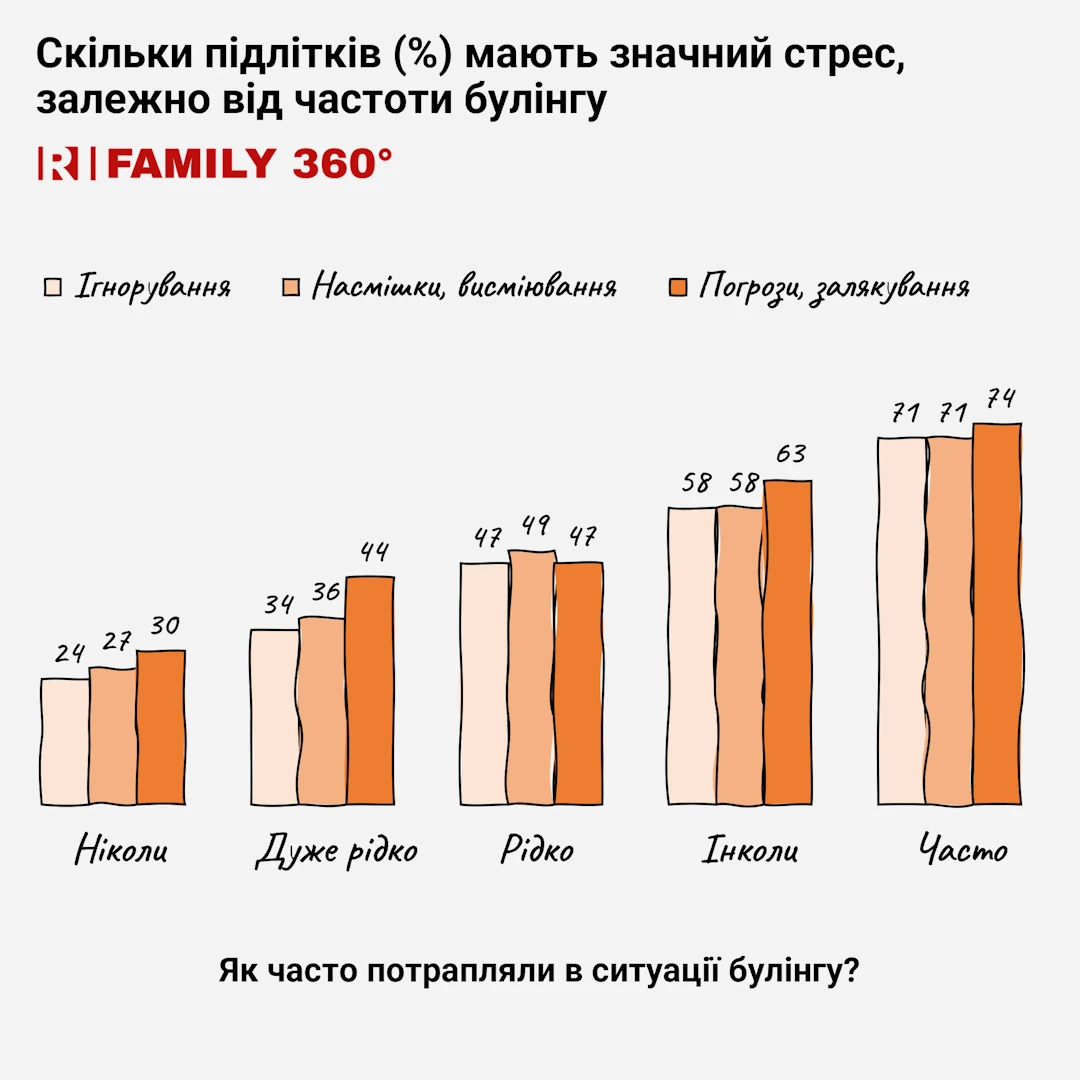
Almost two-thirds of teenagers aged 10-18 have encountered at least one instance of bullying in the last six months. Children who have frequently encountered bullying have twice the level of stress, according to data from Rating Group/Rating Lab.
Bullying is not a ‘childish quarrel’ or a ‘normal part of growing up’ in adolescence. It is a form of violence that affects the psychological well-being not only of the victim of bullying, but also of the entire school, sports club, or any adolescent community. The consequences of bullying can be serious and long-lasting, affecting the mental health, social development and even physical safety of teenagers.
On 20 November, the anniversary of the adoption of the UN Convention on the Rights of the Child, the world celebrates Children's Day. To mark this date, the Rating Group/Rating Lab team has prepared the fifth instalment of its study ‘Changes in the Mental Health and Well-being of Children’. Read on to find out more:
- How common are different forms of bullying among teenagers?
- How is bullying related to the relationship between children and parents?
- What influence do teachers have here?
- How can we help prevent bullying?
In October 2025, Rating Group/Rating Lab surveyed more than 1,500 teenagers aged 10-18 and their parents using the unique Family 360° family research technology. In each publication, we discuss the mental health of teenagers and various aspects of their lives: gadgets and AI, emotional recognition by parents, dreams, household chores and stress, upbringing and punishment in the family, and bullying. Preliminary results of the series of studies can be found at the link.
Note to colleagues and partners:
For over two years, the Rating Group/Rating Lab team has been studying how Ukrainian children, teenagers and families feel. Thanks to the unique Family 360° family research technology, we can see not only the challenges, but also ways to overcome them. We cannot cover this topic with our own resources, and the research needs to be expanded and continued dynamically. Therefore, we are open to cooperation with relevant organisations. For cooperation inquiries, please contact: info@ratinggroup.ua
Forms of bullying: how exactly are teenagers bullied?
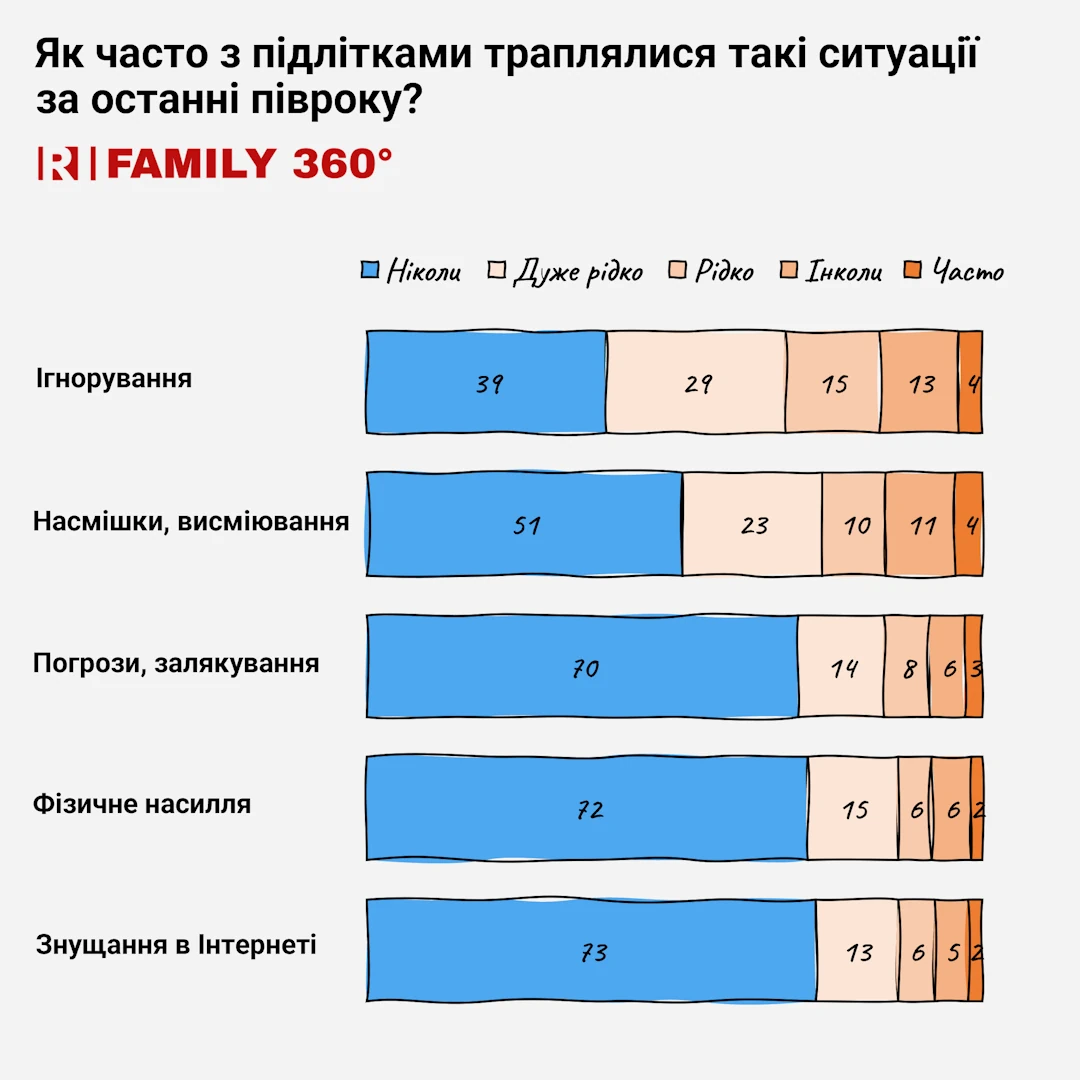
Every teenager can face several types of bullying at the same time. Usually, bullying is not a single act, but a whole range of offensive and/or violent behaviour.
- Ignoring: most teenagers (61%) have experienced this in the last six months. This type of bullying should not be underestimated: systematic ignoring can cause what psychologists call ‘developmental trauma,’ which can later be a sign of certain mental disorders.
- Almost half of teenagers (49%) also experience ridicule and mockery.
- About a third (30%) face threats and intimidation.
- In addition, one in four teenagers is a victim of physical violence, i.e. when they are deliberately beaten, pushed, pinched, hurt (28%), and online bullying (27%), i.e. cyberbullying.
Parents underestimate the extent of bullying against their own children.
This is most true for threats, intimidation and cyberbullying: at least half of parents whose children have been bullied are unaware of it.
Who experiences bullying more?
- Boys experience bullying more often than girls.
- The exception is ignoring, which is equally common among girls and boys.
- Teenagers who have friends experience bullying less often. This is especially true for ignoring, ridicule and cyberbullying.
What does bullying do to a child?
Threats and intimidation cause the most stress.
Bullying creates additional challenges for parent-child relationships
Children who experience bullying are less likely to talk to their parents about their experiences. We cannot say whether children are closing themselves off from their parents or whether parents are unwilling to discuss the topic. This requires further research. However, the data showed that:
- 60% of children who have not experienced bullying often discuss their feelings with their parents. Among those who have been bullied, less than half (46%) do so.
- The topics of ignoring, threats and bullying on the internet are most often silenced.
- Children who have experienced bullying feel a much weaker emotional connection with their parents. First and foremost, this again concerns ignoring and threats.
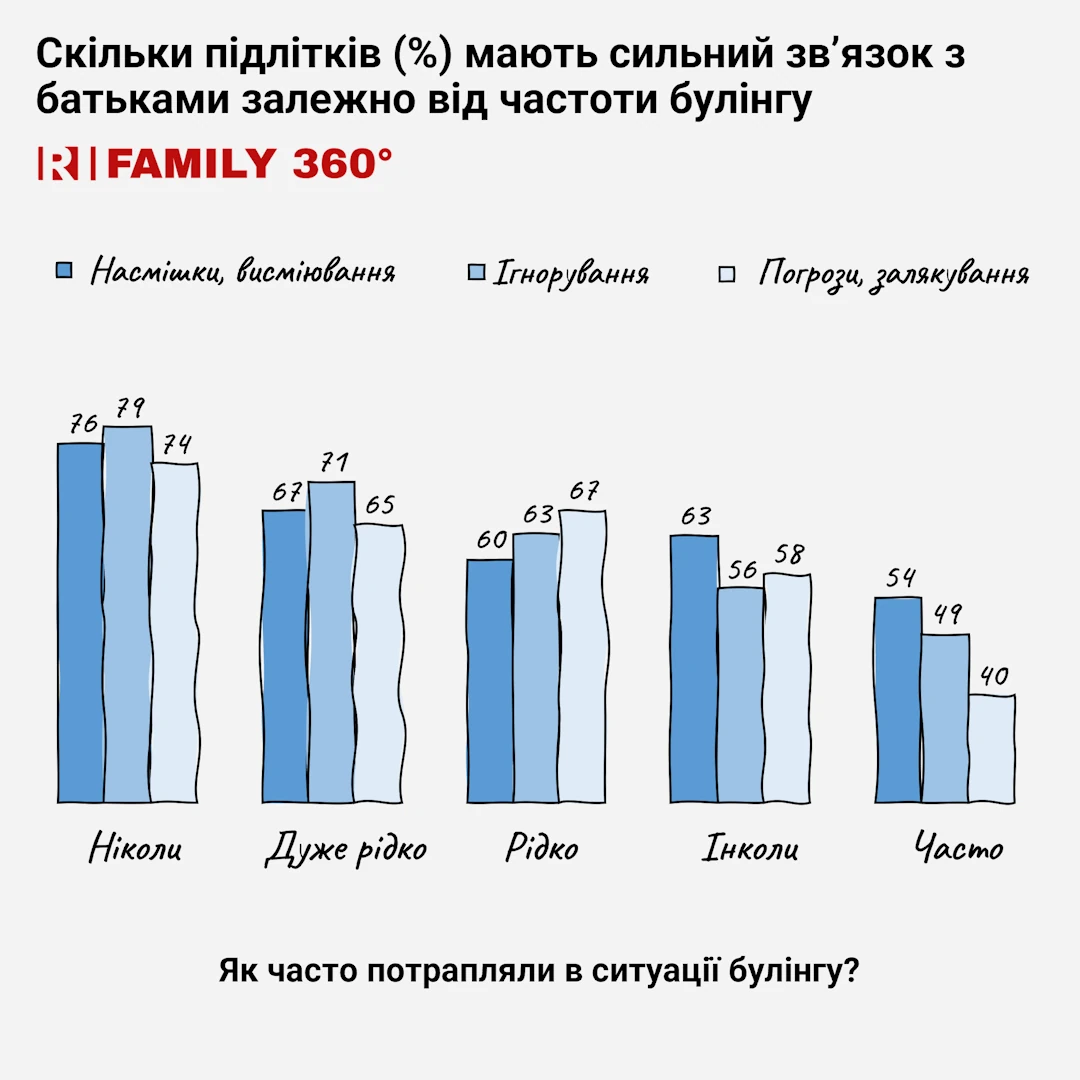
We have previously demonstrated that the frequency of communication with parents affects stress levels. In other words, children who withdraw from communication do not receive the warm, sincere contact with their parents that helps combat stress.
Bullying breeds fear of bullying
Children are actually afraid of being bullied again.
- More than a third (36%) of teenagers who have already experienced bullying openly admit to being afraid of finding themselves in a situation of bullying.
- Among children who have not experienced bullying, this proportion is significantly lower – 22%.
- In general, girls worry about bullying more than boys: 40% of girls and 24% of boys are afraid of finding themselves in such circumstances.
How does bullying affect behaviour in such situations?
We asked teenagers to imagine the following situation: ‘During break time, a group of children are laughing at another child and teasing them. What would you do?’
- 40% would call an adult/teacher.
- 30% would tell the children to stop.
- About 10% would just watch and walk away or even laugh along with the others.
- It is important to note that one in six teenagers was unable to answer.
It is worth noting that teenagers who have experienced bullying are less likely to call an adult (teacher):
- Only 38% of them are willing to call a teacher, compared to almost half (47%) of teenagers who have not experienced bullying.
- Older teenagers aged 14-18 are generally less likely to call a teacher for help (28% vs. 33%).
- Among younger teenagers, the figures are 47% versus 66%.
At the same time, teenagers who have experienced bullying are twice as likely to avoid answering this question (16% compared to 8% among their peers who have not experienced bullying).
What is the role of teachers?
How teachers respond in schools is really important in the context of preventing bullying.
- In schools where teachers are often willing to intervene in situations of possible bullying, bullying occurs less frequently.
- In turn, teenagers in these schools are more willing to call on adults/teachers for help.
Conclusion: what helps prevent bullying?
Bullying is not inevitable. It occurs where there is a lack of attention, support, respect, and clear rules. However, it disappears where there are friends, loved ones, responsible adults nearby, and responsibility in general. So what will help children resist bullying?
- Trusting relationships and communication with loved ones.
- A culture of mutual respect.
- Rejection of bullying others, willingness to intervene and speak out. This applies to children as well as adults and teachers.
By creating such conditions for children, we are not just preventing bullying — we are forming communities where they can feel safe.
About Family 360° technology
It is not worth making conclusions about teenagers without asking their opinion. That is why the Rating Group team launched Family 360° technology for family surveys, which focuses on the child who is being surveyed, as well as their parents, family members and, in some cases, teachers, doctors, psychologists, etc. Comparing the answers of children and their parents allows us to understand the relationships and changes within the family. We have previously used this approach successfully with our partners at UNICEF, KSE, and Ty Yak? when researching mine awareness, mental health, education, and career guidance.
About the study
We first researched the topic of mental health in the parent-child context in October 2024. This year, we decided to continue, expanding the topic and using longitudinal research techniques to better understand the dynamics. In October 2025, this survey covered more than 1,500 children/adolescents aged 10-18 and their parents.
Authors of the research idea: Svitlana Roiz, child and family psychologist, mother of two; Marianna Tkalych, CEO of Rating Lab, Doctor of Psychological Sciences, mother of Masha (17 years old); and Tetiana Skrypchenko, Deputy Director of Rating Group, mother of Solomiia (8 months old).
Methodology
- Fieldwork dates: 3–7 October 2025
- Survey method: CATI>CAWI (Computer-Assisted Telephone Interview – telephone interviews using a computer, CAWI – online survey). In the first stage (CATI), contact was made with parents who gave their consent for their children to participate in the online survey. In the second stage, children completed the survey via a personal link. After that, parents received a personal invitation to take part in an online survey for parents.
- Sample size: 2,531 respondents. Of these, 1,572 were children aged 10-18 and 959 were their parents. Almost 900 children took part in the survey again in a longitudinal format.


.webp)